Signs Your Charity Needs External Fundraising Support
When it comes to charity income generation, most charities won’t reach a definitive moment when they realise they need fundraising support.
Generally, it is a gradual process.
You might notice applications taking longer than expected and deadlines becoming harder to manage. Eventually the quarter lands below forecast and you can’t work out why.
By the time the question reaches a board meeting, the pressure has usually been building for a year or more. Before this happens, many look to external charity fundraising support.
Charity fundraising support covers a range of support services, from short pieces of strategic work through to interim resource that keeps activity moving while a charity recruits. This article sets out the challenges that indicate a charity would benefit from external support and the forms that this support can take.
What is Charity Fundraising Support?
Charity fundraising support is external expertise brought in to strengthen an organisation’s income generation. It is usually delivered by consultants or interim specialists who work alongside the existing team for a defined period rather than joining permanently.
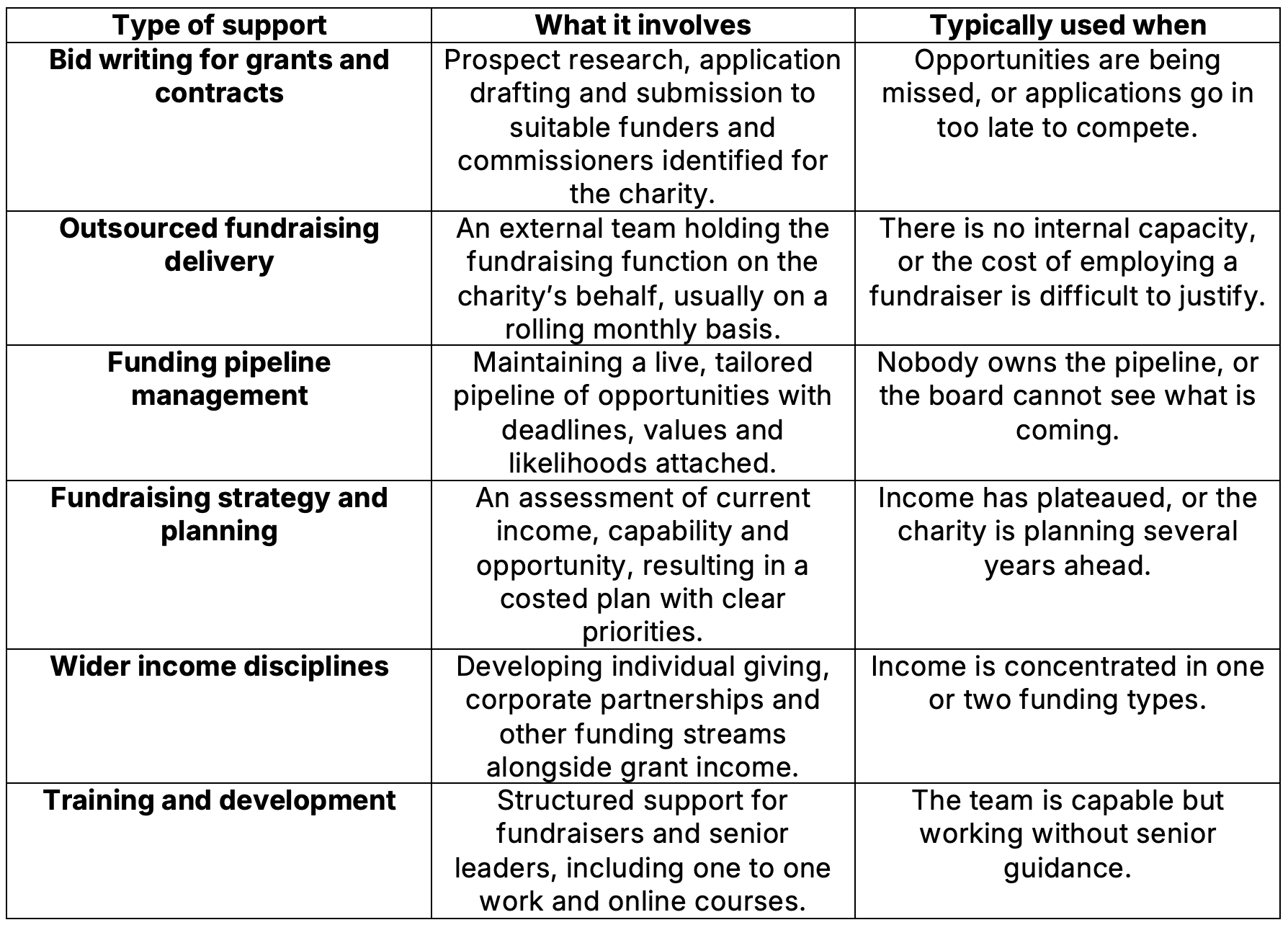
The term covers several distinct types of work, and charities sometimes commission the wrong one because the categories are not always explained clearly.
Most engagements combine more than one of these. A charity that begins with a strategic review often needs delivery support afterwards, because a plan nobody has capacity to execute does not improve income. Equally, a charity that starts with bid writing frequently finds that the work surfaces the strategic questions it had been avoiding.
When Should a Charity Consider External Fundraising Support?
A charity should consider external support when fundraising problems are beginning to repeat themselves and the internal team does not have the time or experience to resolve them properly.
At this point, continuing to add work to the existing team is unlikely to resolve the issue.
The more useful question is: what is getting in the way?
The signs below will rarely appear on their own. Charities usually recognise two or three at once, and it is the combination that indicates the current approach has reached its limit.
Your Team Does Not Have Enough Time for Consistent Fundraising
For many charities, fundraising sits alongside several other responsibilities such as service delivery and staff management. In this case, the lack of fundraising isn’t due to a lack of knowledge or skills; there simply isn’t enough time in the day.
This matters when you consider the importance of consistent communication and relationship building to fundraising. Relationships with trusts, major donors and corporate partners develop over many months, and the organisations that raise money reliably are usually the ones doing small things regularly rather than large things occasionally – something that is harder to do without dedicated capacity.
The main warning sign here is whether fundraising is the first activity to be pushed back whenever something urgent appears.
Fundraising Activity is Busy but Income is Not Growing
This is one of the more difficult positions for a charity to be in, because effort is not the problem. Events take place, applications go out and the team works hard, but income remains flat.
Usually this points to activity spread across too many channels, or to effort concentrated in areas that will never generate the return the charity needs. Community fundraising and small events absorb significant staff time relative to what they raise, and a charity running several of them may be busy in a way that crowds out higher value work.
A practical threshold: if voluntary income has stayed within roughly five per cent for three years while costs have risen, the current approach is no longer keeping pace, regardless of how much activity is taking place.
You Are Missing Suitable Funding Opportunities
Funding opportunities often get missed for two reasons. Either nobody saw the opportunity, or it was seen too late to produce a competitive application. Both come back to the same underlying issue, which is that prospect research requires dedicated time and is almost always the first thing to be dropped.
The signs are recognisable. Applications going in close to the deadline. The same small group of funders approached year after year. A sense that other charities in the area seem to hear about things first.
How many funders new to the charity have been approached in the past twelve months, and how many of those were identified through deliberate research rather than by chance?
Your Charity Relies Too Heavily on One Source of Income
Where a single funder, contract or event accounts for more than a third of income, the charity’s plans depend on decisions it does not control. The risk is well understood by most boards. What is harder is finding the capacity to do anything about it while the dominant income stream is still performing.
Diversification is slow work. Building a new income stream to the point where it contributes meaningfully takes eighteen months to two years, and that timescale does not shorten under pressure. Charities frequently begin the work at the point where the risk has become urgent, which is the hardest moment to start.
External support will not remove concentration risk overnight, and it is worth being wary of anyone who suggests it can. What it does do is get the work moving at a point when the charity still has time for it to matter, rather than after the dominant funder has given notice.
You Do Not Have a Clear Fundraising Strategy
There is a difference between a fundraising plan and a fundraising strategy.
A plan is a list of activities and dates. A strategy sets out which audiences the charity is going after, why those audiences rather than others, what the work will cost, and what it should return.
The absence tends to show up in specific questions. What does it cost this charity to raise £1? Which income stream should grow next year, and by how much? What would the charity stop doing if it had to choose? Where these cannot be answered with reference to evidence, activity is being driven by habit and by whatever arrived most recently in an inbox.
Your Charity Is Preparing for Growth or Change
A new service, a capital project, a merger, the end of a major contract or a shift in the charity’s operating model all change what fundraising has to deliver. The requirement usually changes before the organisation does, which is why this work is best started around twelve months ahead of the change itself.
Charities often approach it in the opposite order. The decision is taken, the service is designed, and fundraising is asked to find the money afterwards. By that stage the case for support has to be built retrospectively, and funders can generally tell.
Trustees or Senior Leaders Lack Confidence in the Funding Pipeline
This sign is different from the others because it concerns assurance rather than income. The board is asking whether future funding is secure, and the executive team cannot answer with data that would satisfy a sceptical trustee.
It shows up as forecasts revised repeatedly through the year, pipeline discussions that rely on optimism about applications not yet submitted, and board papers that report on activity rather than on expected income and its likelihood. Where a board cannot see the pipeline clearly, it cannot govern income properly, and the problem is as much a governance one as a fundraising one.
What Kind of Fundraising Support Does Your Charity Need?
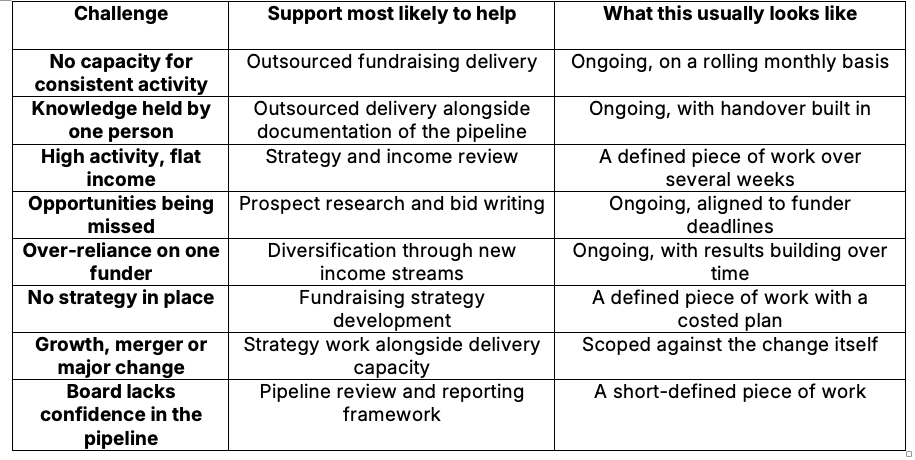
Matching the challenge to the right kind of support matters more than the decision to seek help at all. The table below sets out the pairings that come up most often.
The variable that most affects how quickly this work produces results is not the size of the charity. It is how much usable information already exists about past income and current supporters.
The variable that most affects how quickly this work produces results is not the size of the charity. It is how much usable information already exists about past income and current supporters.
How VMC Consulting Can Help
Recognising the need for fundraising may be straightforward, but actually finding the capacity to address these requirements while continuing to run the charity is often where charities struggle.
VMC Consulting works with charities on exactly this. We do not use templates or employ salespeople. We only take on work we know we can deliver. Charities come to us for bid writing, prospect research, individual giving, corporate partnerships and fundraising strategy, and many hand over their fundraising to us entirely.
Race Council Cymru, for instance, outsources its fundraising to us, and we have secured more than £700,000 in new income for them with an ROI of 32 for every £1 invested.
Our income generation work runs through a flexible rolling monthly contract at £21,600 a year. A full-time fundraiser costs more than that in salary alone, before recruitment, on-costs and the management time that never appears in the business case. For charities that want a clearer picture of their fundraising and a realistic plan for improving it, speak to our expert team of charity consultants today.