What Is The Charity Governance Code and Why Does It Matter?
Good governance is one of those phrases that gets used a lot in the charity sector. Most trustees and senior leaders know it matters, but fewer have the time and headspace to step back and ask what it should look like in practice.
That is where the Charity Governance Code is useful.
The Charity Governance Code is a practical framework for charity boards. It helps trustees look at how their charity is led, how decisions are made, how risk is managed and whether the board has the right processes in place. It is not a legal requirement, and it does not replace Charity Commission guidance or trustee duties. It instead gives boards a clear way to review whether governance is genuinely helping the charity do its job well.
This can shape how the organisation thinks, prioritises and challenges itself moving forward.
What is the Charity Governance Code?
The Charity Governance Code sets out best practice regarding how a charity's board operates and makes decisions. It applies to charities in England and Wales only, as Scotland and Northern Ireland have their own separate governance codes.
It is designed as a practical tool for trustees and boards, helping them review how their charity is led and how well the board is working. The Code is reviewed and refreshed periodically by a cross-sector steering group with charity-sector and governance expertise.
The latest version was refreshed in 2025 and is built around eight universal principles:
Foundation
Organisational purpose
Leadership
Ethics and culture
Decision-making
Managing resources and risks
Equity, diversity and inclusion
Board effectiveness
Together, these principles help to assess whether the board is doing more than meeting its basic obligations. They help to assess how well a board understands the charity and whether governance is strong enough to support the charity’s purpose.
That makes the Code useful for different types of charities:
A small charity might use it to bring more structure to board meetings or clarify trustee responsibilities.
A larger charity might use it to review board effectiveness, risk oversight, delegated authority or the quality of information going to trustees.
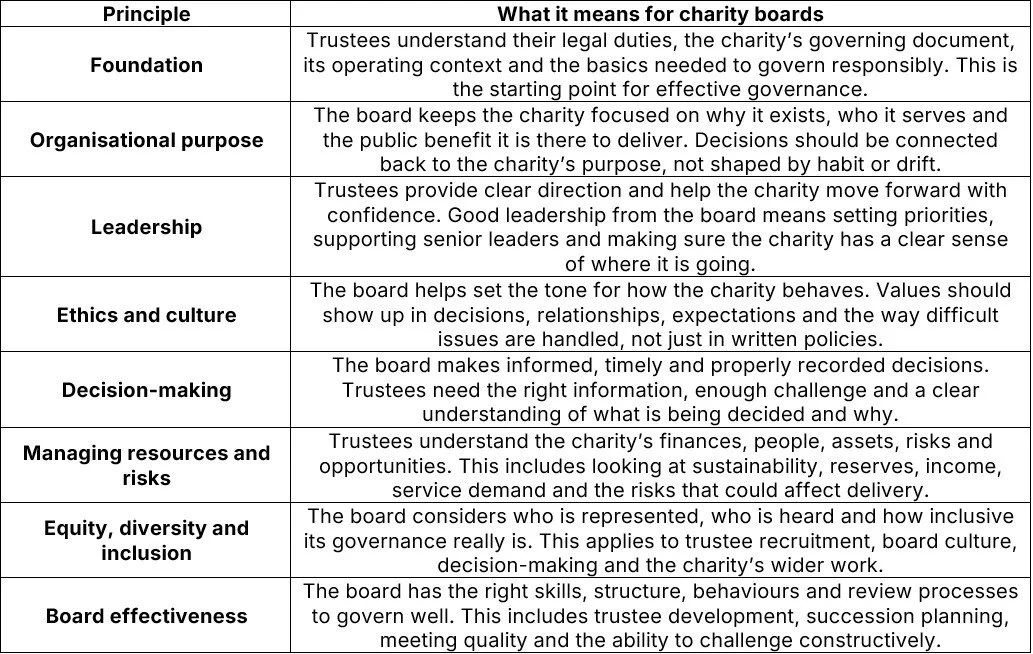
What are the eight principles of the Charity Governance Code?
The 2025 Charity Governance Code is built around eight principles. Each one looks at a different part of how a charity is governed.
These principles are most useful when they are prompting honest discussion. They help trustees understand where governance is working well, where there are gaps, and what needs to change going forward.
Why does the Charity Governance Code matter?
The Charity Governance Code matters because it helps trustees identify where structural and leadership issues lie and allows for a fast response to any flagged issue. Adherence to the code can affect:
How confident funders, partners and commissioners feel about the organisation.
Whether trustees can challenge constructively.
Whether senior leaders have clarity.
Whether the charity can make difficult decisions without drifting.
How quickly potential problems can be identified.
It also gives trustees a shared language with CEOs and senior teams as well as a clear definition of what good governance is.
What changed in the latest 2025 Charity Governance Code?
As the first update since 2020, the current 2025 Charity Governance Code places more emphasis on how boards behave in practice. It is not only concerned with whether structures exist, but it looks more closely at culture, ethics, decision-making, inclusion and how trustees work together.
Most charities already know they need policies, minutes, risk registers and terms of reference, but the latest code puts more focus on whether governance is actually working. It asks boards to think about behaviours, evidence and assurance.
In plain terms: how do trustees know that what they have agreed is making a practical difference?
Who should use the Charity Governance Code?
The Charity Governance Code is written primarily for trustees and boards, but its value reaches further than the boardroom. Good governance affects how decisions are made, how leaders are supported, how risk is understood and how confidently the charity can move forward.
That means the Code can be useful for several groups across a charity.
Trustees and charity boards
For trustees, the Code provides a clear framework for reviewing board effectiveness. It can support trustee induction, skills reviews, governance action planning and board development.
It also helps boards step back from day-to-day details and ask whether they are providing the charity with the right level of oversight, challenge, and strategic direction.
Useful questions for trustees might include:
Do we understand our role and responsibilities clearly?
Are we spending enough time on the decisions that matter most?
Do we have the right skills and experience around the table?
Are we receiving information that helps us govern well?
Can we evidence how our governance supports the charity’s purpose?
CEOs and senior leadership teams
For CEOs and senior leadership teams, the Code can help clarify what the board needs in order to provide effective oversight.
This might include sharper reporting, clearer delegated authority, better risk information or more focused strategic discussions. It can also help reduce friction between board and executive roles by making expectations clearer.
Growing charities
Many organisations reach a point where informal ways of working no longer hold. The charity may have more staff, larger contracts, more complex services, greater scrutiny or new income pressures. The governance model that worked a few years ago may not be strong enough for the next stage.
This does not always mean hiring permanent in-house resources. Sometimes the need is more specific: an independent review, a refreshed governance framework, better board reporting, support with trustee development, or help aligning governance with strategy and income generation.
Funders, commissioners and stakeholders
The Code can also help charities demonstrate credibility to funders, commissioners, partners and other stakeholders.
Following the Code does not guarantee funding or remove the need for scrutiny. What it does provide is a stronger basis for showing that governance is being taken seriously. It helps charities explain how decisions are made, how risks are managed and how trustees are holding the organisation to account.
How charities can use the Charity Governance Code
The best way to use the Charity Governance Code is as a practical review tool and a way to prompt discussion over box-ticking.
A board does not need to address every principle at once, and in most cases, it is better to start with the areas that carry the most risk or would make the biggest difference.
A useful first discussion might focus on questions such as:
Where is our governance working well?
Where are we relying on habit rather than evidence?
Which decisions are hardest for us to make?
What information does the board need but not currently get?
Where are trustees too close to operational detail?
What would give the board greater confidence?
Do we have the capacity to make improvements ourselves?
The Code uses an “apply or explain” approach. In practice, this means charities are encouraged to apply the principles and outcomes, or explain why a different approach is appropriate for their circumstances.
That is helpful because good governance should be proportionate and ensure that trustees understand the choices they are making and can explain them clearly.
For many boards, the most valuable output is a realistic action plan. Not a long list of theoretical improvements, but a focused set of changes that will improve how the charity is led. The important word is realistic. Governance improvement fails when it becomes too abstract. It works when trustees can see what needs to change, why it matters and who will move it forward.
How VMC Consulting can help
Strong governance gives charities confidence. It helps trustees lead well, supports senior teams to deliver and gives funders, commissioners and partners greater assurance that the charity is being run with care.
But governance improvement takes time, objectivity and experience. Many charities can see the pressure points. What they do not always have is the internal capacity to address them properly.
VMC Consulting helps charities turn governance review into practical action.
That might mean reviewing governance arrangements, strengthening board reporting, supporting trustees, improving decision-making, aligning strategy with income generation, or helping a charity move from discussion to delivery.
For charities that want stronger governance, clearer decisions and more confidence about the road ahead, speak to our expert team of consultants today.